Living neurons learn to navigate, pointing to a smarter future for robotics
NeurIPS 2026 research from Cortical Labs and Honda Research Institute Europe demonstrates how biological intelligence could help intelligent systems (including robots) learn and adapt using less data and energy.
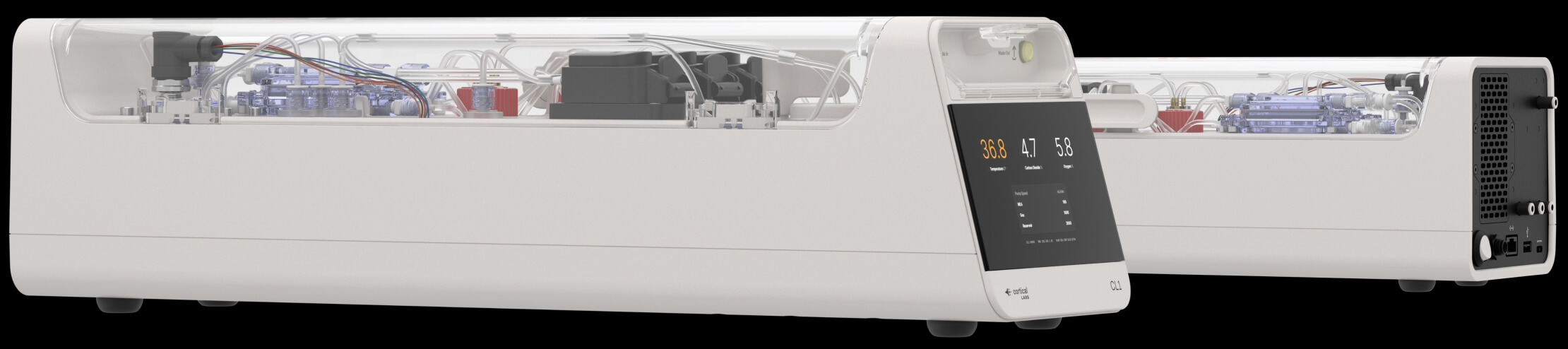
Melbourne, Australia, 12 October – Using Cortical Labs’ CL1 biological computers, researchers from Cortical Labs and Honda Research Institute Europe have trained a virtual agent to navigate towards a target in a simulated environment.
As intelligent systems become increasingly capable of running and performing complex physical tasks, a major challenge remains: giving them the intelligence to navigate, learn and adapt.
Using living neural cells rather than classical artificial intelligence, the researchers have demonstrated a navigation system that can learn from limited information while using a fraction of the data and energy required by silicon-based systems.
Accepted into NeurIPS 2026, one of the world’s leading artificial intelligence and machine learning conferences, the research introduces the Embodied Neurocomputation Framework, a standardised and scalable method for training biological neural networks. It addresses a central challenge in biological computing: translating digital information into electrical signals that living neurons can understand and learn from.
Using Cortical Labs’ CL1 biological computers, researchers trained a virtual agent to navigate towards a target in a simulated environment. The study involved 26 connected CL1 units, more than 4,000 hours of agent-environment interaction and approximately 1,300 training configurations.
From these tests, researchers identified 12 configurations that consistently demonstrated learning, with biological neural networks performing as well as, and in some cases better than, conventional machine learning models.
“This research collaboration enables us to investigate fundamentally different approaches to intelligent agents. Using living cells as the core computational substrate comes with many challenges but also offers great potential in terms of energy efficiency, robustness, and adaptation—potential that we can now begin to explore and evaluate,” said Daniel Tanneberg, Senior Scientist, Honda Research Institute Europe.
From virtual navigation to physical movement
Separately from the HRI Europe collaboration and outside the NeurIPS study, Cortical Labs has continued exploring how biological navigation systems could be applied to physical machines.
In an independent demonstration developed by Cortical Labs, navigation decisions generated by a biological neural network were translated into the movements of a robotic dog. HRI Europe was not involved in developing the demonstration.
Dr Brett J. Kagan, Co-founder and CEO of Cortical Labs, said the research provides a glimpse into how biological intelligence could help address one of robotics’ biggest remaining limitations.
“Robots that are becoming remarkably capable machines at their physical control, still struggle with the higher order control required to learn quickly or adapt when conditions change. Walking, running, and doing acrobatics is amazing, but determining where and when to do actions remains a challenge with traditional methods” Dr Kagan said.
“Classical AI generally tackles that problem through scale: more data, more computing power and more energy. Biological intelligence works differently. It can rapidly adapt, respond to feedback, and achieve efficiencies not possible through traditional computing .
“The robotic dog is a simple demonstration of how progress in biological systems can also be applied into the real world, but it helps make the opportunity tangible. Longer term, this approach could support robots and autonomous systems that need to make decisions in unpredictable, real-world environments.”
Potential applications include industrial robots that can adjust to changing conditions, autonomous systems operating in remote or hazardous environments especially where energy supply may be limited, and assistive robots that need to respond to individual users.
Johnson Zhou, Research Software Engineer at Cortical Labs, said the work also helps move biological computing beyond individual experiments towards a repeatable engineering discipline.
“The challenge is not simply growing neurons on silicon. It is finding reliable ways to communicate with biological systems, train them and understand which approaches produce consistent results,” Mr Zhou said.
“This research gives us a framework for testing those questions at scale. It establishes a foundation we can build on as biological computing moves towards practical applications.”
The findings build on Cortical Labs’ earlier demonstrations of living neurons performing computer-based tasks, including Pong and DOOM. While those projects showed that neurons could interact with digital environments, the navigation research brings biological computing closer to applications in robotics and autonomous systems.
The next stage will be improving the rate at which these systems learn, allowing biological intelligence to respond and adapt in real time.