Living neurons complete standard AI computing tests at a fraction of the energy cost and 1/60th the data
Research from Cortical Labs shows that human stem-cell-derived neural networks can pass recognised computational benchmarks at 30 watts of power, versus the thousands consumed by conventional AI hardware
Cortical Labs has demonstrated that a computing system built from living human neurons can pass established tests used to evaluate artificial intelligence systems. The finding represents a significant step forward for biological computing as a viable, energy-efficient alternative to conventional silicon-based AI.
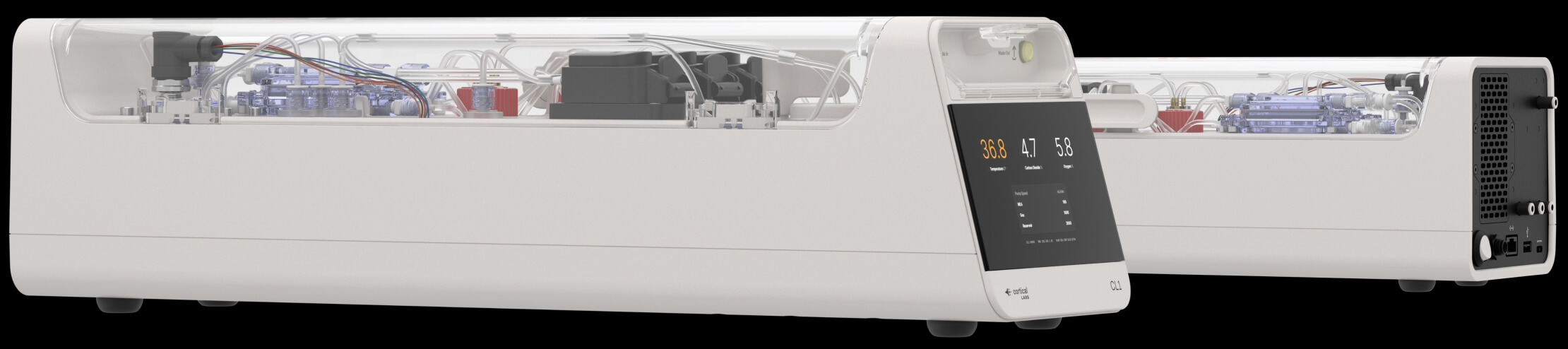
The research released as a pre-print article was conducted in collaboration with scientists from Tohoku University, using Cortical Labs' CL1, the world’s first code deployable biological computer.
To demonstrate that the CL1 can perform meaningful computation, researchers tested it against established benchmarks used to evaluate AI and computing systems. The first was the MNIST dataset, the standard test for measuring a system's ability to recognise handwritten digits. This is the same benchmark used across the AI industry to establish whether a system can handle real-world pattern recognition. Other tasks include classifying single space-based signals, and Morse code decoding, a task that requires processing information sequentially across time, not simply reading a single input. Sequential processing is inherently harder for biological systems, because it requires the network to hold context from one moment to the next, rather than responding to a single stimulus.
Structured biological networks achieved up to 88% accuracy on MNIST and more than 95% accuracy on Morse code. The Morse code result, in particular, demonstrates the system can handle dynamic, time-based data, the class of tasks most relevant to real-world computing applications.
Dr. Brett Kagan, CSO/COO, Cortical Labs, said **“**what this research gives us is a working foundation — biological networks that compute consistently, predictably, and at benchmarks the broader industry recognises. That consistency opens the door to the next set of questions: how do we model the progression of neurological disease, and how do we build processors that learn and adapt the way biological systems naturally do. With the systems now ready, we can start to build.”
Why this matters: the problem silicon cannot solve
The AI industry is approaching an energy crisis. By 2030, global data centre electricity consumption is projected to more than double to 945 terawatt-hours, more than Japan's entire electricity consumption today. AI is identified as the primary driver of that growth. At the same time, the chip technology powering that growth is turning into a hurdle. Silicon transistors have now shrunk to the scale of individual atoms. At this stage, electrons behave unpredictably, and further miniaturisation becomes unreliable. The computing industry is confronting a problem that it cannot build its way to efficiency using the same materials and architectures that created the problem.
The response from the research community has been to look toward biology. The human brain processes roughly 1,000 trillion operations per second on less than 20 watts of power, a benchmark that no silicon system has come close to matching. Most attempts to replicate this have used silicon chips designed to mimic brain behaviour. Cortical Labs is working with actual living biology: a fundamentally different approach, and one this research brings closer to commercial application.
Dr. Alon Loeffler, Senior Application Scientist, Cortical Labs, "the energy trajectory of AI is not sustainable on silicon alone. If the industry continues on its current path, the infrastructure required to power it will outpace what grids can realistically deliver. Biology has always offered a fundamentally different answer to that problem — the question was whether we could make it reliable enough to matter. This research shows we can.”
Achieving reliable performance required solving a problem that has held biological computing back: stability. When stimulated, loosely structured neuron cultures tend to collapse into a state of runaway electrical synchronisation, a system reset that makes useful computation impossible.
The Cortical Labs team resolved this by growing neurons inside constrained microfluidic devices that force them into structured, modular networks. The physical architecture acts as a governor, keeping the network operating at the high-activity state optimal for computation — what researchers describe as the "edge of chaos". This is the central discovery of the research hinges on the fact that simply having living brain cells is not enough. They must be physically organised to compute reliably.
What this opens up:
By demonstrating that structured biological networks can pass recognised computational benchmarks, this research establishes biological computing as a functional architecture and not just a laboratory concept. The 30-watt operating footprint of the CL1 positions it as a viable low-power option for the classes of pattern recognition and sequential processing tasks that currently drive significant energy demand in AI infrastructure.
The platform also carries direct implications for medicine and neuroscience. By modelling how different brain regions affect information processing in a controlled system, the CL1 can be used to study human cognitive function and test potential treatments for neurological conditions.
More detail
Add paragraphs, headings, quotations, links and images using the editor toolbar.