Cortical Labs unveils HIVE: massively parallel and integrated clusters of biocomputing units, integrated to unlock next generation capabilities
Nature-inspired approach from Cortical Labs connects multiple biological computers to solve problems collectively and more effectively.
Washington D.C., October 26th – Cortical Labs has today unveiled a new technology called HIVE at The International Conference on Organoid Intelligence. This world-first approach integrates multiple biological computers powered by living neurons in a scalable and parallel manner so they can solve problems collectively, with capabilities and stability outperforming any single biocomputer.
HIVE is designed to overcome the three biggest barriers to practical biological computing.
- individual neural cultures naturally vary in their performance and can change over time. For example, HIVE raised symbol classification accuracy from 79.8 per cent (±4) to 99.1 per cent (±1), using as few as seven workers (individual biocomputers).
- More complex tasks can be broken down into simpler components and provided across multiple units. Using this approach in early testing, HIVE’s best-performing configuration was on average 252% times more effective than conventional machine-learning model comparisons in dynamic navigation tasks.
- Individual cultures losing activity no longer requires experiments to be restarted. If individual cultures fail, the HIVE protocol can continue with significant robustness.
Short for Highly Integrated Virtual Ensembles, HIVE takes its inspiration from the way intelligence and collective action are organised in nature; for example, individual workers in a beehive collaborating towards a shared goal.
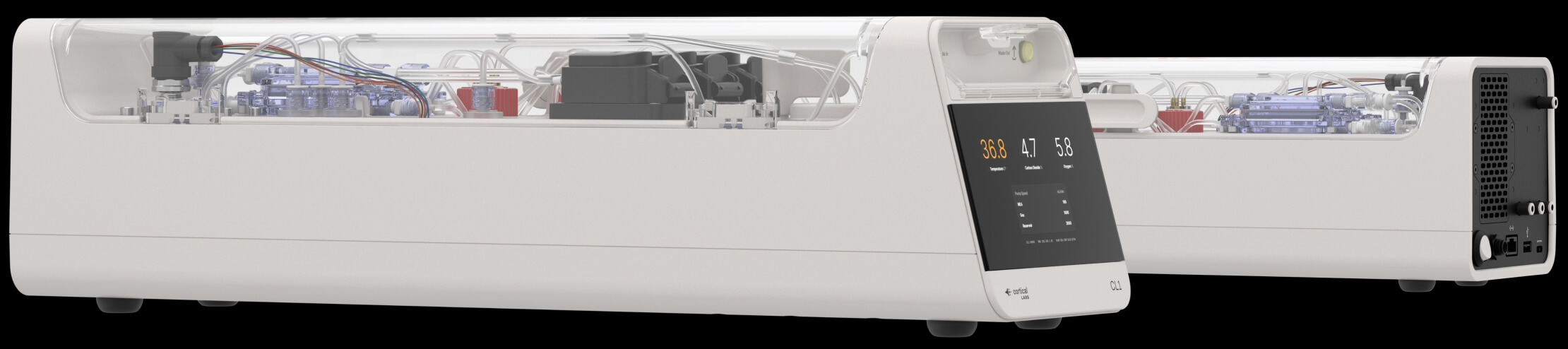
HIVE applies the same principle to Cortical Labs’ CL1—the world’s first code-deployable biological computer. For HIVE, Cortical Labs connected 15 CL1 systems, with each unit comprising approximately 200,000 living human neurons and interfaced silicon hardware. When given a collective task, the CL1s could vote on the same decision, specialise in different parts of a task or process information through virtual layers.
By enabling these biological computing units to operate as one coordinated system, HIVE could help move the technology beyond individual experiments towards larger, more reliable and resilient applications.
Dr Brett J. Kagan, Co-founder and CEO of Cortical Labs, said HIVE could provide the reliability and scale needed to make biological computing practical.
“Biological computing has enormous potential, but useful systems cannot depend on a single culture performing perfectly every time,” Dr Kagan said.
“Nature solves complex problems collectively. Brains distribute information across specialised regions, while hives rely on many workers each with their own functions contributing to a shared outcome. HIVE applies that same principle to biological computing, creating systems that can be more consistent, resilient and capable than any individual culture.”
“Discrete neural information processing systems working together is not new to nature, except now we have a scale that can transcend physiological limits, made possible by the incredible control, scale, and hardware integration allowed by Cortical Labs’ CL1 platform.”
Putting HIVE to the test
Cortical Labs tested HIVE using a virtual navigation task in which an agent had to move through a grid and locate a target.
Researchers trialled two configurations. In the first, multiple neural cultures voted on the agent’s next move. In the second, a “mixture of experts” divided the task between specialist groups responsible for different movements.
The conventional Deep Q-Network used as a comparison achieved approximately 32 per cent of the maximum possible score, while the best-performing solo CL1 reached approximately 40 per cent.
Preliminary results found that the voting HIVE achieved approximately 70 per cent. The mixture-of-experts HIVE reached approximately 80 per cent—2.5 times the score of the conventional LLM model.
Johnson Zhou, Scientist at Cortical Labs, said the results showed how working collectively could help biological computing systems manage the natural variability of living neurons.
“One culture might perform particularly well on a given day while another does not,” Zhou said.
“When cultures work together, those individual differences have less influence over the final result. HIVE gives us a way to manage that variability while drawing on the adaptability that makes biological systems so powerful.”
Cortical Labs will continue testing larger HIVE configurations and refining how information is delivered to the neurons, how their responses are interpreted and how feedback supports learning.